
Material Matters: It's not "just cardboard", I promise

Updated: Aug 20
Solid board vs corrugated: two different jobs
Ask most people what a carton is made of and you'll get one answer: cardboard. Fair enough — but "cardboard" is doing an enormous amount of hiding in that sentence, because it covers two genuinely different materials that behave in completely different ways.
Solid board is a single, dense sheet of compressed paperboard. Most of the time it's coated on one side only — the face that ends up on the outside of the carton — giving you a beautifully smooth, print-ready surface exactly where it counts. It's why solid board is the material behind the vast majority of the folding cartons you'll find on a shelf: cosmetics boxes, cereal packs, pharmaceutical cartons, the lot. Corrugated board, on the other hand, is a sandwich: two flat liners with a wavy fluted layer glued in between. That fluting is what gives corrugated its extra cushioning and crush resistance, but it also makes the surface less friendly to fine detail printing — you're printing onto something with a slight ripple underneath it.

Here at Quantum, we're a solid board specialist first and foremost, and that's a deliberate
choice — it's where our presses, our tooling and our expertise are all focused. But we've got the flute options covered too. We regularly print directly onto N flute, one of the finest "micro-flutes" available, so fine it holds detail almost as well as solid board while adding a bit of rigidity underneath. For E flute — a step up in thickness, for jobs that need a touch more structural muscle, think multipacks or products that take a rougher ride in transit — we take a different route: we print a thin top liner flat, to the same standard as our solid board work, then laminate (glue) that liner onto a corrugated sheet beneath it, a process sometimes called post-print lamination. You get the crisp, detailed print quality solid board is known for, sitting on top of a properly rigid fluted structure.
FBB, kraft-back and recycled: picking the right solid board
Solid board itself isn't one thing either — there's a small family of grades, and each one earns its keep somewhere different.
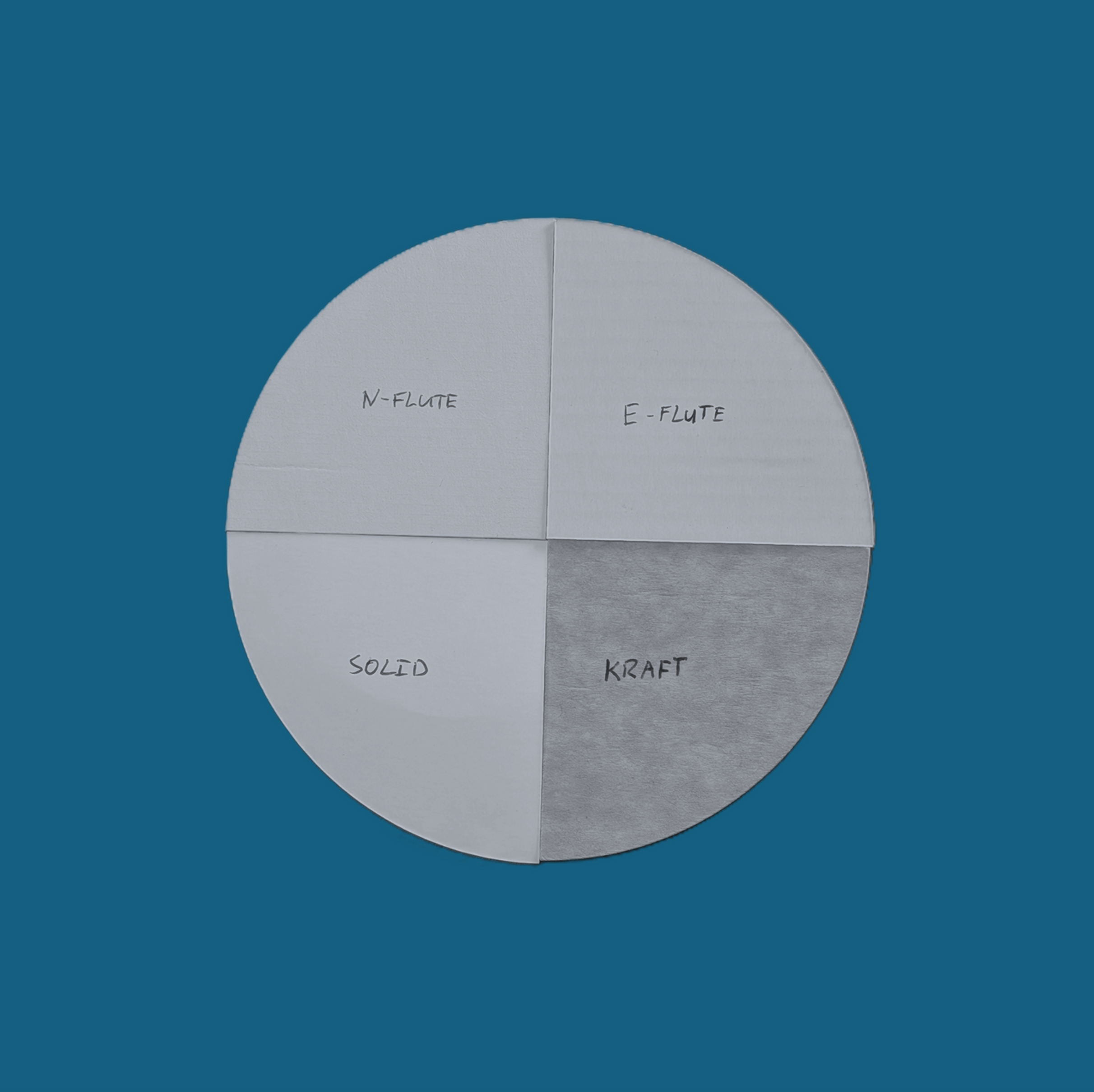
Folding box board (FBB) is the workhorse, and it's what most of our cartons are made from. It's coated on the front to give you a bright, smooth surface that takes ink beautifully, with a duller, uncoated finish on the reverse. We print on that reverse side all the time, and for almost every job it comes out looking every bit as sharp as the front. The only people who reliably spot any difference are our own printers — colour is their whole world, day in and day out, so they've got the kind of eye that can catch the tiniest shift in tone between one uncoated batch and the next. That's less a limitation of the board and more a reflection of how fussy we are about getting it right.
Kraft-back board swaps that clean white reverse for a natural brown kraft liner, and it's not just an aesthetic choice — kraft fibre is genuinely tougher, with better resistance to moisture and knocks. That's exactly why you'll see it so often on drinks packaging: multipacks of bottles or cans go through a rougher ride than a lipstick box, and that extra strength on the reverse makes a real difference.
Then there are recycled boards, made largely or entirely from reclaimed fibre. They won't quite match virgin board for brightness or top-end print performance, but for a huge range of products they do a properly good job at a friendlier price point — and with a smaller footprint to boot.
Weight and thickness: why GSM isn't the whole story
Two numbers get thrown around a lot when specifying board, and it trips people up constantly: GSM and caliper. GSM (grams per square metre) tells you how heavy the board is for a given area. Caliper tells you how thick it physically is, usually measured in microns.
Here's the bit that catches people out — the two don't always move together. You can have two boards with an identical GSM that feel noticeably different in the hand, because one is denser and the other is bulkier, with more air trapped between the fibres. A "bulkier" board can give you the stiffness and stand-up strength you want on shelf at a lower weight, which matters for cost and for sustainability alike — less fibre for the same performance is a genuine win. The job of a structural designer is partly about matching caliper to the carton's size and the weight of what's going inside, rather than just reaching for a heavier board because it feels like the safe option. More material isn't automatically a better carton; it's just a more expensive one.
Grain direction: the fold you never think about (until it goes wrong)
This is the one that gets me genuinely excited, and it's completely invisible to the end customer — as it should be, if we've done our job properly.
Paperboard fibres line up in a dominant direction during manufacture, much like the grain in a piece of wood. Fold with that grain and you get a clean, crisp crease that snaps shut and holds its shape. Fold against it and you're fighting the fibres — the crease can crack, whiten unattractively along the fold, or leave the carton with a slight bow that never quite sits flat. I've watched a carton go from "why won't this fold right" to perfect just by rotating the layout 90 degrees on the sheet, and it's genuinely one of the most satisfying fixes in the job.
Getting this right means thinking about grain direction at the layout stage, before a single sheet is cut — making sure the main fold lines on the design run parallel to it. It costs nothing extra to get right and causes no end of trouble when it's missed, which is exactly why it's one of the first things we check on any new structure.
Size, waste and lead time: the trade-off behind "made to measure"
Here's a decision that happens long before a carton reaches a press, and it has real consequences for both cost and timing.

Wherever we can, we buy board cut to match the exact size we need for a job, rather
than working from generic stock sheets and accepting whatever offcut waste that leaves behind. The upside is straightforward: less wasted board means a more efficient job, and that efficiency shows up as a lower cost for you, alongside a smaller environmental footprint — which matters given how much of this industry's sustainability story rests on using material wisely, not just recycling it afterwards.
The trade-off is time. Made-to-measure board relies on our suppliers cutting stock specifically to size, which takes longer than pulling from a ready-cut, generic stock sheet sitting in a warehouse. So a bespoke size will typically mean a longer lead time than a job that happens to fit a standard, off-the-shelf sheet size. Neither approach is "wrong" — it's a genuine trade-off between cost efficiency and speed, and it's one worth discussing early if your timeline is tight, so we can find the right balance for your project.
Where this leaves us
Choosing a board is never really one decision — it's four or five smaller ones stacked together: solid or corrugated, which grade, what weight, which way the grain runs, and what size sheet gets you there most efficiently. Get them right and nobody notices; the carton simply works, folds cleanly, prints beautifully and turns up on time. Get one wrong and suddenly everyone notices.
Next up in this series, we're following the carton from board to press — how litho and digital printing actually put ink onto all of this, and why colour consistency is harder to achieve than it sounds.
Got a packaging puzzle of your own? The team at Quantum Print & Packaging would love to hear about it.

Comments